What am I doing?
Not the rhetorical version of “what am I doing”, the actual, real world one that hangs over me, and no doubt plenty of other people too, like Schrödinger’s Sword of Damocles. The answer we give may, or may not, have actual concrete consequences depending on what version of the unbearably vague question we are or perhaps equally importantly, are not, answering as well. With me the question “what am I doing” tends to get complex, meta and overcooked in a hurry. It’s a bit like time travel, only in the present, where a seemingly inconsequential thing changes everything; us oldies know we have to let the pacifist campaigner get hit by the car. (Star Trek)
There is a lot that you can read about the importance of a morning routine; to be honest, it isn’t going to change your life unless it is literally changing your life. There is a difference between the minimum and potential maximum change that mixing up something in your life can make. Writing a morning journal answers the immediate practical question of what am I doing; I am sitting at my desk writing words on paper. It is not that deep; that is, for me, the minimum change.
I have tried to keep a journal or diary before and failed! When I started nearly a year ago, I thought it would be fun to keep a sort of junk journal, stick ephemera and in my mind create the beautiful aesthetic spreads that I had seen online. I envisaged a suitably whimsical affair that I would want to share and revisit. The thing is, I am not, at present, a junk journaling ephemera collecting aesthetic spread sort of a person. However, what I did discover is that I really enjoyed the writing part; the act of writing with a fountain pen I found therapeutic.
For someone tethered to a keyboard for a couple of decades at least this was both a revelation and the chance to tickle an itch. I have long loved fountain pens as object d’art but not really had the opportunity to spend any time really writing with them, perfect. Still in the first flush of enthusiasm, all I had to do was decide what to write. The decision of how often was easy with my week splitting nicely into 4 days where it would be super easy to write and 3 where it was not so easy. So, what do I write 4 mornings a week, this is exactly where I had tripped up before. Without the pressure of trying to write every day, now I would have to have something to say.
Faced with the blank page, the question, what am I doing, becomes immediately relevant. Immediately I thought that I had to write something meaningful, to leave a profound legacy, you know, do something “worthwhile” with the time; I couldn’t just “document” my life because I am not a “documenting” person. For reasons unknown to me, I realised I was walking into a trap, like the biggest trap, the one Marxists warned me about. I was thinking that I had to be productive, that my time had to result in value. I was thinking that my activity had to be deemed valuable. I was measuring myself against the metric of me only having value that is measured by my output.
Right now, our value is determined more than ever by volume metrics, be that likes, subscribers, or another simple measure that tells us nothing about how valuable what we have produced is. These metrics are obtained by regular “content”. A phrase that, for me, inherently devalues the product. A Van-Gogh in the Musée d’Orsay is not gallery content; or is it? Is the Tate a content repository now? Does that make artist spaces into content farms?
The need to justify my activity via its utility or added value directed me away from writing at all. I have not been immune to the conditioning that doing something for the sake of doing it is a frivolous endeavour. Writing for the sake of writing? Surely there is something better, “more productive” that I could be doing with my time? We don’t walk to enjoy a walk; we do it to exercise, do steps, be fitter, collect a bucket list of views. I argued with myself that it can be different things at the same time, but we really don’t work that way. If I am writing for future value in my writterings, then each word is significant, each sentence needs to be crafted, the paragraphs have to flow, and the piece has to be planned, directed and marshalled in support of the cause. Writing that has value has direction; it is a purposed, planned and orchestrated endeavour. My journal most certainly is not.
If I write to enjoy writing, then my words don’t matter; they don’t have to be in sentences, the paragraphs don’t have to make sense, and the piece can be disjointed and nonsensical. It is whatever I make it; if I could draw, then I could include drawings or even just go with making marks, as long as what I was doing made me happy. The goal is enjoying what I am doing while I am doing it.
Doing something to enjoy it is a rebellious act in the capitalist society we live in. Social media has monetised and sold every human activity back to us. I think it was Shoshana Zuboff who said that the only thing left to be monetised was sleep, and we have now done that very comprehensively too. (I know there go any mattress deals in the future along with the smartwatch ones). I am questioning my activities through the unforgiving lens of capitalism, and that my disability is assessed via its impact on my ability to add capitalist value, because I have internalised disempowering beliefs, just like I have internalised ableism. I am telling myself that the journal I write isn’t worth it because it's not adding value to society directly in the manner that my indoctrination tells me is a legitimate use of time that I hitherto had been asleep. If I am not getting ready to add value, then I have to be actively adding it, and we wonder why people are getting burnt out?
What went differently this time, I guess, is that I noticed. For all the evil of the algorithm, it has shown me that I am not alone in my experience of navigating life with disability. I have become aware of my situation vis-à-vis society as an outsider; that I have always been an outsider, and that to society I will always be an outsider. Both the neurodivergent and the disabled are forever “other” in the narratives of our societies. Me asking what I am doing, feeling powerless, and feeling that society directs aggression and violence towards me and others like me, is not a symptom of personal failure but is a product of me having the capacity to recognise and process what is happening around me contextually.
Struggling with my immediate day-to-day survival meant my horizon was limited. The choices I made, largely to survive and do my best to cope, have led me to where other disabled and neurodivergent people are. We are overthinking our lives and realising that we don’t need to justify our existence. That’s a full stop. Society is insisting that we are pushed out past the margins and boundaries, that we somehow stop being human. Society has been here before; we have the camps, we have the others; the question in my mind is not what is next, but when.
Which is a somewhat terrifying conclusion. It sounds dramatic when I read it out loud; and the voices in Europe were melodramatic in the 1920s and 1930s too; the voices were melodramatic before Trump’s election. A fire alarm sounds really dramatic because something dramatic is about to happen. Polarised society, the debasement of truth, anti-intellectualism, scapegoating societal others, the shifting of economic responsibility and blame from the cause of the problem to the victims, it is DARVO at the societal level.
And here I am back where I started, aware that my agency only goes so far, and that mine goes further than others who, like me, are on the fringes and margins of society too. I am not hopeful; the older I get, the more I see that the people I have made friends with are the exception, not the rule. That I am part of a community that really isn’t like most of society; a community that is excluded because we are not part of their violent tribe and want no part of it. We see what you call normal, and no thank you.
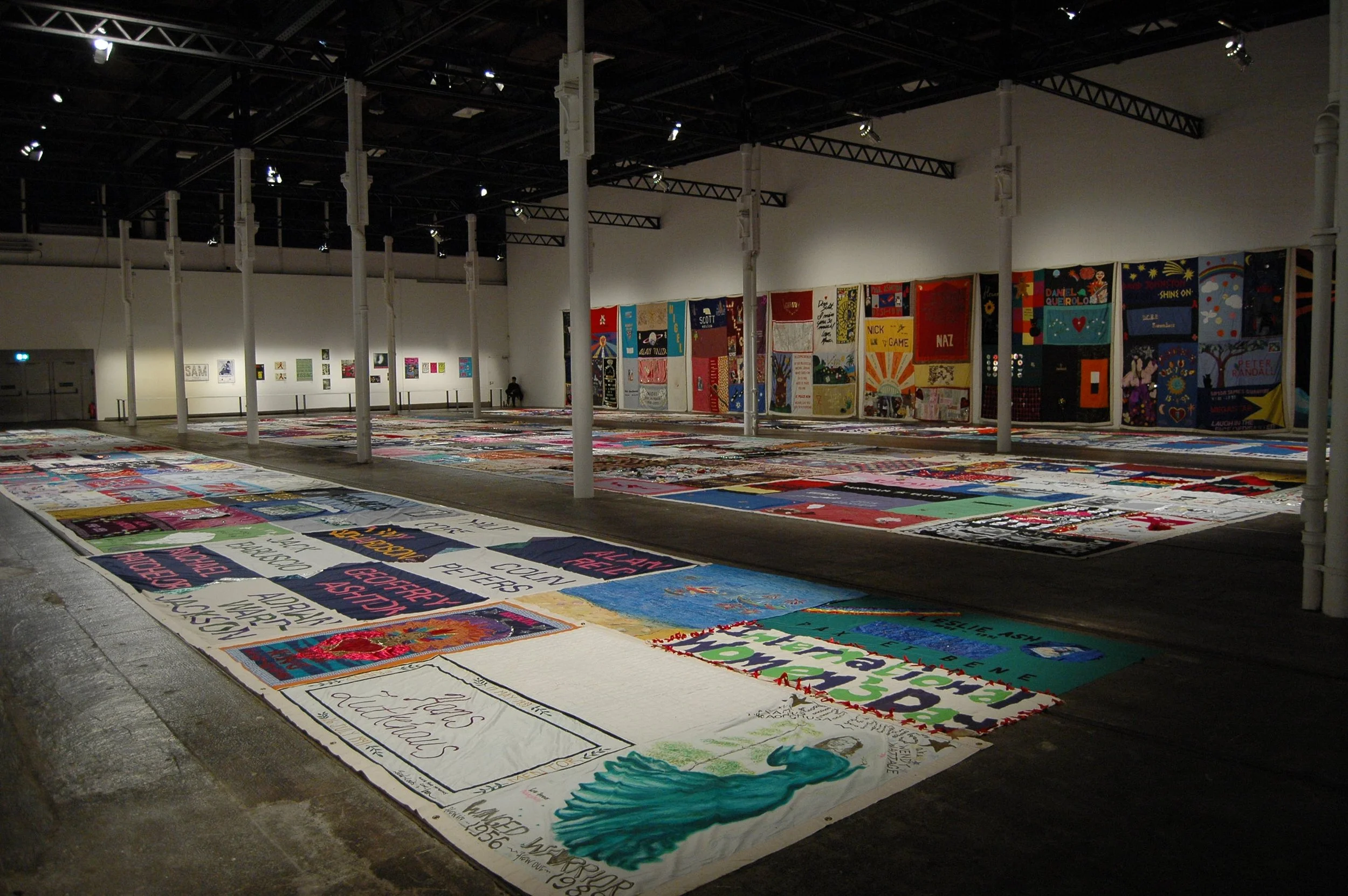
To finish, the AIDS Memorial Quilt is, an enduring reminder of what “normal people” do to those they no longer see as human, and the contrasting humanity of those society casts out.